Showing posts with label Magical Realism. Show all posts

Monday, 11 March 2019

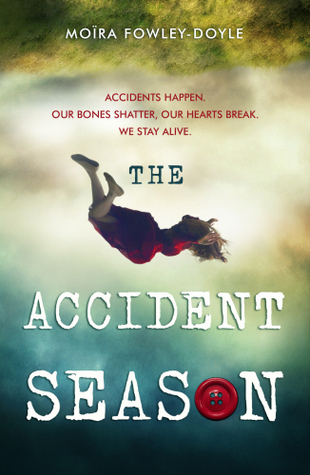
The Accident Season by Moïra Fowley-Doley

23346358
Description from Goodreads

A bewitching, dark and beautiful debut novel about a girl living in the shadow of a mysterious curse.

It's the accident season, the same time every year. Bones break, skin tears, bruises bloom.

The accident season has been part of seventeen-year-old Cara's life for as long as she can remember. Towards the end of October, foreshadowed by the deaths of many relatives before them, Cara's family becomes inexplicably accident-prone. They banish knives to locked drawers, cover sharp table edges with padding, switch off electrical items - but injuries follow wherever they go, and the accident season becomes an ever-growing obsession and fear.

But why are they so cursed? And how can they break free? 


I'm going to have a hard time reviewing this book. The Accident Season has an addictive quality to it - I read the whole book in one sit. It was eerie and melancholy, borderline magical realism, and a little disturbing. Everything the author aimed it to be, I'm guessing. While reading, I felt like I was in a dream, just floating in someone's memories. Everything around me disappeared, and that sensation is always something that I seek when reading. I want to experience something that I couldn't even imagine. The Accident Season accomplished it.

There is a twist/surprise element near to the end. A lot of people have said that they saw the twist coming, but for once, I didn't see it coming. It would be interesting to read the book a second time, now that I know what is coming. Would the book be still as mesmerizing and have the same kind of magical realism feel to it the second time around? Maybe, most likely not. That being said I think the book is best experienced knowing little as possible when going into the book. At best it surprises you and leaves you a bit hollow inside, in a good way. 

Now about the one element, a lot of people have very strong opinions on. It might be a small spoiler, but it is introduced very early on in the book: the romance between the main character Cara and her ex-stepbrother.  To be honest, I'm not sure myself yet what I think of this, I just finished reading the book. While I do not like the idea of sister/brother romance, this wasn't exactly it as they weren't related by blood. They both knew it was "weird" (as they put it) and they struggled against it, but does it make it acceptable? I don't know, but I'd really love to hear the author's thoughts on this. Why did Fowley-Doley decide to make the love interest ex-stepbrother? The romance wasn't the main theme in the book, but it was a significant part. The book is more about how broken we are, and how we can still live on despite it. But I think some readers might find the romance off-putting, this time it was ok, in my opinion. 

I find it very hard to pin-point the whole reading experience - did I just really read all of that? Did that all happen? Now, I can't say that book was 5/5 stars because sometimes the characters were a tiny bit too teenager-y (so angsty and rebellious) and while the writing was captivating, it tended to drag on at times. But I did like The Accident Season. It had a clear concept, it provoked so many emotions in me (both good and bad), I liked the surprise element, and I will remember the book for a longer than just this one evening when I read it. If you liked All Our Pretty Songs by Sarah McCarry and We Were Liars by E. Lockhart, The Accident Season is also for you. 

4/5 stars

Friday, 5 June 2015

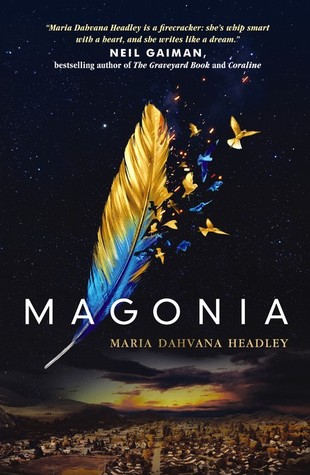
Magonia by Maria Dahvana Headley

Description from Goodreads

Aza Ray is drowning in thin air. 

Since she was a baby, Aza has suffered from a mysterious lung disease that makes it ever harder for her to breathe, to speak—to live. 

So when Aza catches a glimpse of a ship in the sky, her family chalks it up to a cruel side effect of her medication. But Aza doesn't think this is a hallucination. She can hear someone on the ship calling her name.

Only her best friend, Jason, listens. Jason, who’s always been there. Jason, for whom she might have more-than-friendly feelings. But before Aza can consider that thrilling idea, something goes terribly wrong. Aza is lost to our world—and found, by another. Magonia. 

Above the clouds, in a land of trading ships, Aza is not the weak and dying thing she was. In Magonia, she can breathe for the first time. Better, she has immense power—and as she navigates her new life, she discovers that war is coming. Magonia and Earth are on the cusp of a reckoning. And in Aza’s hands lies the fate of the whole of humanity—including the boy who loves her. Where do her loyalties lie?


Magonia was unlike anything that I've read before. I mean, it did have some kind of similarities with for example The Girl at Midnight and The Fault in Our Stars, but the novel as an entity was so different, so compelling. I was completely absorbed in the story, and while at times it was so dense with fantasy and emotions, I just couldn't stop reading. And of course (a cherry on top ) Magonia was madly beautifully written. 

Aza Ray is 15-years-old (nearly 16) when the novel starts, meaning 7 years younger than I am now. So to be completely honest, I was struggling to connect with her, at first. My first impression of her was that even though she was highly intelligent and loyal, she was also somewhat resentful. But I mean who wouldn't be if you've had a mystery disease no one could cure, and the doctors have numbered your days a long time ago already? When you have lived in a glass bubble your life? The more the novel progressed, the more I started to understand Aza Ray's behaviour and words, and how all it was just coping with the disease she had bore for all her life. She needed to be the smart-ass and know-it all. She wouldn't have survived otherwise. And it was heart-breaking to realize this. 

The magical realism element of the novel was so unexpected, because it isn't really mentioned in the blurb. And that's excellent! Keep it that way, because I thought Magonia (and to be honest, all books) is best read when known as little as possible about it. Headley definitely has a talent to write not only vivid visual scenes, but also what kind of inner experiences the character(s) go through. Because, first I was sobbing, and then on the next page I was mentally gawking and mesmerised by the subsequent events. I absolutely adored how the author had created the magical realism element in her book, a bit of factual knowledge here and then some fantasy elements there. Not only this was fun to read, it was also fascinating to know about these mysterious historical events which had actually happened and learn words like kuulilennuteetunneliluuk (an Estonian word for the part of the gun a bullet goes through). 

And yes, the language. It was so beautifully quirky, yet smart and captivating. It definitely had its own trademark and some people may not be able to appreciate it, but I just... I loved it. The extreme variations between sentence lengths, the long descriptions, the constant inner monologue were just spot on with a magical realism novel like this. And of course the changing typography Headley had used was perfect. Because, changing typography has to be one of the most powerful elements in changing the mood, and expression of emotions and ideas. 

Magonia was also a tear-jerker for me. I cried twice rather hideously, because Headley knew exactly which heart-strings to pull. Tears were just streaming down my face, I just couldn't help it. And I can tell you that these things happened in the beginning-ish and right in the end. That being said, I though that the first half of the book was marvellous - absolutely 5 stars material. But then something happened, I'm not sure if it was because the pace slowed down or what, but the remaining half(excluding the ending) wasn't as good as the first part. For me, Magonia lost some of its shine through the reading journey, even though I was kept on my toes and surprised from time to time. 

If I had to describe Magonia with one word, it would be mesmerising. I was mesmerised by the concept, the intelligent and sharp voice of the main character, and the seedless blending of fact and fiction. I had extremely high expectations for Magonia, but I wasn't disappointed. Even though the blurb gave me a different kind of idea what the novel would be like, I can honestly say that my mislead ideas weren't a disadvantage for the novel itself. A beautiful read, on so many levels.