Description from Goodreads
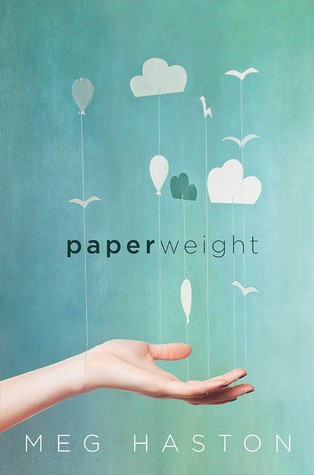
Seventeen-year-old Stevie is trapped. In her life. In her body. And now in an eating-disorder treatment center on the dusty outskirts of the New Mexico desert.
Life in the center is regimented and intrusive, a nightmare come true. Nurses and therapists watch Stevie at mealtime, accompany her to the bathroom, and challenge her to eat the foods she’s worked so hard to avoid.
Her dad has signed her up for sixty days of treatment. But what no one knows is that Stevie doesn't plan to stay that long. There are only twenty-seven days until the anniversary of her brother Josh’s death—the death she caused. And if Stevie gets her way, there are only twenty-seven days until she too will end her life.
In this emotionally haunting and beautifully written young adult debut, Meg Haston delves into the devastating impact of trauma and loss, while posing the question: Why are some consumed by their illness while others embark on a path toward recovery?
❄❄❄
Paperweight was most definitely an emotional read. When I was 17-18, I did have a somewhat rough patch with my own self-image. I never had an eating disorder, but I most definitely was uncomfortable in my own skin - I didn't feel like my mirror reflection equaled to what I really was. I guess you could say that I tried dieting and exercising, never excessively, but just enough to lose a couple of pounds. It was a weird feeling of having control over your physique and being successful in it. And that felt really good, taking into consideration that I've always been a perfectionist. However, (luckily) over time I steadily accumulated a better sense of self-esteem and self-worth, and I'm today I can say that I don't perceive my weight to be a defining element of who I am as a person. As a contrast, in Paperweight, the main character Stevie feels like her weight is everything that she is.
The novel isn't the easiest one to read, not only because of the topic, but also because of the raw emotions of guilt and anger Stevie felt. I have a tendency to binge-read (no pun intended) but I couldn't do it with Paperweight simply because it was so loaded with emotions. I became consumed with Stevie in her roller coaster of painful memories and self-destructive goals. The novel is told in flashbacks to a year before she was admitted to the treatment centre and in the present, so the readers get a real sense what are the causes and motives behind Stevie's self-destructive behaviour. Stevie isn't always likeable - she lashes at people, is unwilling to cooperate, and judges people. But it's important to keep in mind that she is sick. Very sick. Her models of thinking are completely contorted with her unhealthy fixations on Anorexia Nervosa and obsession of redeeming herself through a suicide.
I really appreciated the fact that Haston wasn't any where near at glorifying what Stevie was going through. To have an eating disorder, a dysfunctional family, a dead brother, feeling like no one really accept you as you are, having virtually no friends, experiencing abandonment, all of these equalled must create a very difficult environment for someone to live in. Haston described all the unglamorous binge events and the euphoria following them, the guilt which torn Stevie apart for lacking control over her eating, and the constant burden of feeling responsible for her brother's death. I rarely cry-cry while reading (I might get teary eyed), but I did shed quite many tears towards the end of this novel. All the emotions and their release was a so powerful that I just sobbed like a little child towards the end. Haston mentions in the author's note, that she has gone through something similar ('a survivor' she called herself), and I think the readers can really see it - there was just something really personal about in the writing and it just shone through.
Even though I acknowledge that the society in which we live in has a lot to do with developing an eating disorder, I thought it was interesting that the author hadn't decided directly to focus on media and its portrayal of women, but instead how an eating disorder for Stevie was a mean to obtain control and power over herself, as well as a way to gain approval from her mother. Haston decided to take a different kind of angle at the topic and it paid off - Stevie's story felt authentic, believable, and I never got the impression that having an eating disorder is something trivial.
The novel stirred something in me, mostly bringing memories back when I was worried about my own body and how its appearance reflected me as a person. I still occasionally have thoughts such as "oh, look at my thighs, they're huge", but Paperweight gave me a very poignant reminder that anxiety over your weight isn't worth it. Paperweight was also able to explore the devastating loss of a loved one as well as poisonous relationships driving one to desperate actions. A really memorable, yet difficult read.
☆☆☆☆